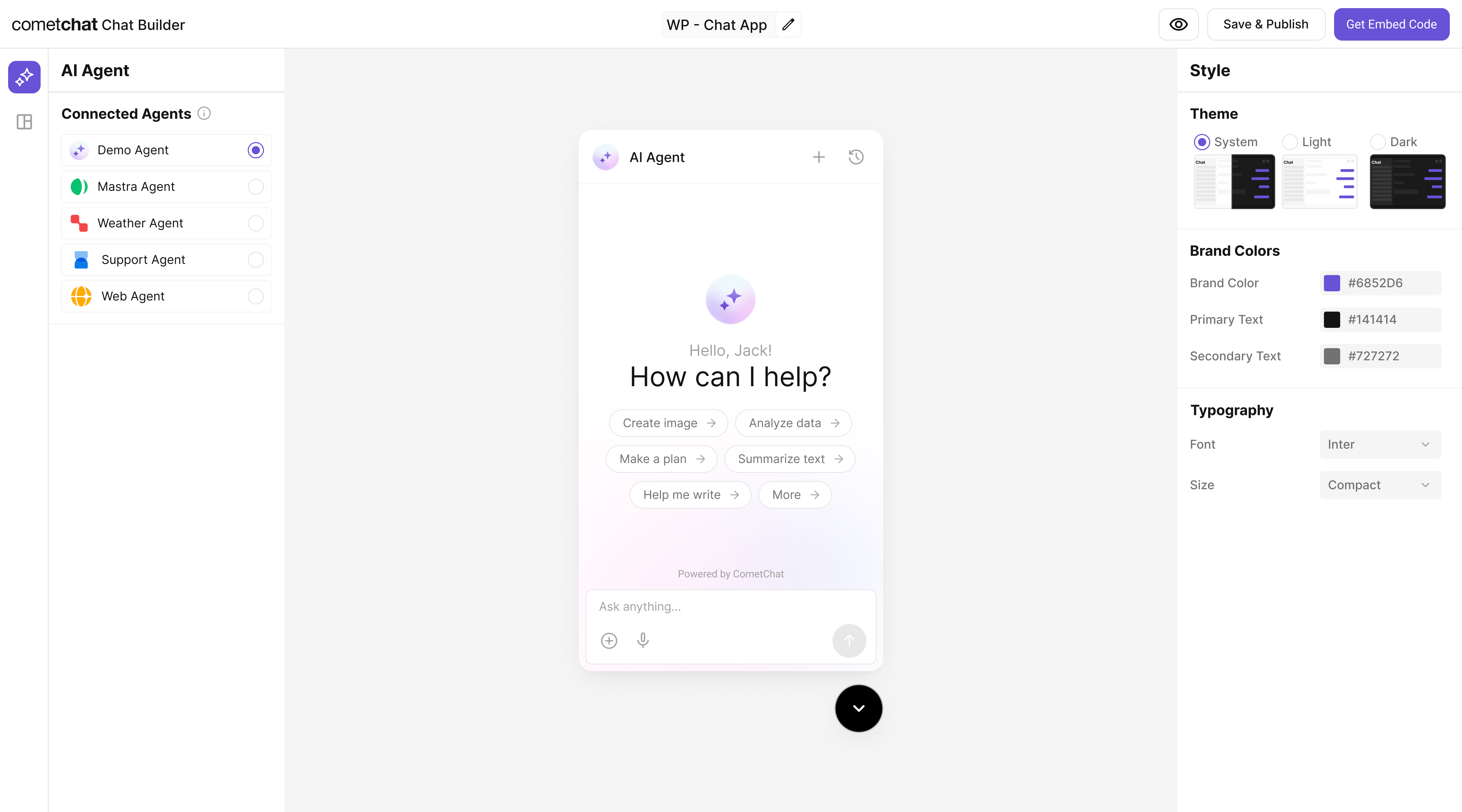
What you’ll build
A Vercel AI SDK agent with streaming + tools
The same agent connected to CometChat (Agent ID + Deployment URL)
A customized chat experience using UI Kit Builder
An export to React UI Kit code or Chat Widget for integration
Prerequisites
A CometChat account and an app: Create App
A Vercel AI SDK agent (HTTP endpoint) plus the adaptor package:
vercel-cometchat-adaptor
Node.js environment with: ai, @ai-sdk/openai, zod, and Express (or another HTTP framework)
Step 1 - Create your CometChat app
Copy credentials
Note your App ID , Region , and Auth Key (needed if you export the Chat Widget later).
Step 2 - Connect your Vercel AI SDK Agent
Navigate to AI Agent → Get Started and then AI Agents → Add Agent .
Choose provider
Select Vercel AI SDK .
Basic details
Provide:
Name and optional Icon
(Optional) Greeting and Introductory Message
(Optional) Suggested messages
Vercel configuration
Paste/define:
Agent ID — a unique handle that matches how you route traffic (e.g., support).
Deployment URL — the public HTTPS endpoint that receives CometChat requests.
(Optional) Headers — JSON auth headers that your endpoint expects.
Save & enable
Click Save , then ensure the agent’s toggle is ON in the AI Agents list.
Tip: The vercel-cometchat-adaptor handles conversion between CometChat events and the Vercel AI SDK. Keep the Agent ID and Deployment URL stable so you don’t need to reconnect.
Step 3 - Define Frontend Actions (Optional)
Add an action
Go to AI Agent → Actions and click Add to create a frontend action your agent can call (e.g., “Open Product,” “Start Demo,” “Book Slot”).
Define fields
Include: Display Name — Shown to users (e.g., “Open Product Page”).Execution Text — How the agent describes running it (e.g., “Opening product details for the user.”).Name — A unique, code-friendly key (e.g., open_product).Description — What the tool does and when to use it.Parameters — JSON Schema describing inputs (the agent will fill these).
Validate inputs (schema)
Example parameters JSON: {
"type" : "object" ,
"required" : [ "productId" ],
"properties" : {
"productId" : {
"type" : "string" ,
"description" : "The internal product ID to open"
},
"utm" : {
"type" : "string" ,
"description" : "Optional tracking code"
}
}
}
Handle in your UI
At runtime, listen for tool calls and execute them client-side (e.g., route changes, modals, highlights).
Step 4 - Customize in UI Kit Builder
Open variant
From AI Agents click the variant (or Get Started) to enter UI Kit Builder.
Customize & Deploy
Select Customize and Deploy .
Adjust settings
Update theme, layout, and features; confirm the Vercel agent is attached.
Preview
Use live preview to validate responses & any tool triggers.
Step 5 - Export & Integrate
Choose how you’ll ship the experience (Widget or React UI Kit export).
The Vercel AI SDK agent from Step 2 is included automatically in exported variants—no extra code needed for basic conversations.
Decide delivery mode
Pick Chat Widget (fastest) or export React UI Kit for code-level customization.
Widget path
Open UI Kit Builder → Get Embedded Code → copy script + credentials.
React UI Kit path
Export the variant as code (UI Kit) if you need deep theming or custom logic.
Verify agent inclusion
Preview: the Vercel agent should appear without extra config.
Step 6 - Deploy & Secure (Reference)
Need a public Vercel AI SDK agent? Use these reference blocks to define, expose, and deploy one securely.
Define your Vercel AI SDK agent
// vercel/agent.ts
import { streamText , stepCountIs , tool } from "ai" ;
import { openai } from "@ai-sdk/openai" ;
import { z } from "zod" ;
const weatherTool = tool ({
description: "Get a simple temperature estimate for a location" ,
inputSchema: z . object ({
location: z . string (). describe ( "City or region to check" ),
}),
outputSchema: z . object ({
location: z . string (),
temperature: z . number (),
}),
execute : async ({ location }) => {
// Replace with a real data source; this is a stub.
return {
location ,
temperature: 72 + Math . floor ( Math . random () * 10 ) - 5 ,
};
},
});
export async function runVercelAgent ({
messages ,
tools = {},
} : {
messages : any [];
tools ?: Record < string , unknown >;
}) {
return streamText ({
model: openai ( "gpt-4o-mini" ),
stopWhen: stepCountIs ( 100 ),
messages ,
tools: {
weather: weatherTool ,
... tools ,
},
});
}
Expose a CometChat-compatible endpoint
TypeScript (Express)
JavaScript (Express)
// server.ts
import express from "express" ;
import cors from "cors" ;
import bodyParser from "body-parser" ;
import {
convertCometChatMessagesToVercelMessages ,
convertCometChatToolsToVercelAISDKTools ,
mapVercelStreamChunkToCometChatEvent ,
} from "vercel-cometchat-adaptor" ;
import { runVercelAgent } from "./vercel/agent" ;
const app = express ();
const port = process . env . PORT || 4000 ;
app . use ( cors ());
app . use ( bodyParser . json ());
app . post ( "/agent/vercel" , async ( req , res ) => {
try {
const cometChatTools = Array . isArray ( req . body . tools )
? convertCometChatToolsToVercelAISDKTools ( req . body . tools )
: {};
const messages = convertCometChatMessagesToVercelMessages ( req . body . messages );
if ( ! Array . isArray ( messages ) || messages . length === 0 ) {
return res . status ( 400 ). json ({ error: "Invalid request" });
}
res . setHeader ( "Content-Type" , "text/event-stream" );
res . setHeader ( "Cache-Control" , "no-cache" );
res . setHeader ( "Connection" , "keep-alive" );
const runId = req . body . runId || `run_ ${ Date . now () } ` ;
const threadId = req . body . threadId || "thread_1" ;
const stream = await runVercelAgent ({ messages , tools: cometChatTools });
for await ( const chunk of stream . fullStream ) {
const events = mapVercelStreamChunkToCometChatEvent ( chunk );
for ( const event of events ) {
event . runId = runId ;
event . threadId = threadId ;
event . timestamp = event . timestamp || Date . now ();
res . write ( `data: ${ JSON . stringify ( event ) } \n\n ` );
}
}
res . end ();
} catch ( error ) {
console . error ( error );
res . write (
`data: ${ JSON . stringify ({
type: "error" ,
message: "Agent processing failed" ,
timestamp: Date . now () ,
}) } \n\n `
);
res . end ();
}
});
app . listen ( port , () => {
console . log ( `Server running at http://localhost: ${ port } /agent/vercel` );
});
// server.js
const express = require ( "express" );
const cors = require ( "cors" );
const bodyParser = require ( "body-parser" );
const {
convertCometChatMessagesToVercelMessages ,
convertCometChatToolsToVercelAISDKTools ,
mapVercelStreamChunkToCometChatEvent ,
} = require ( "vercel-cometchat-adaptor" );
const { runVercelAgent } = require ( "./vercel/agent" );
const app = express ();
const port = process . env . PORT || 4000 ;
app . use ( cors ());
app . use ( bodyParser . json ());
app . post ( "/agent/vercel" , async ( req , res ) => {
try {
const cometChatTools = Array . isArray ( req . body . tools )
? convertCometChatToolsToVercelAISDKTools ( req . body . tools )
: {};
const messages = convertCometChatMessagesToVercelMessages ( req . body . messages );
if ( ! Array . isArray ( messages ) || messages . length === 0 ) {
return res . status ( 400 ). json ({ error: "Invalid request" });
}
res . setHeader ( "Content-Type" , "text/event-stream" );
res . setHeader ( "Cache-Control" , "no-cache" );
res . setHeader ( "Connection" , "keep-alive" );
const runId = req . body . runId || `run_ ${ Date . now () } ` ;
const threadId = req . body . threadId || "thread_1" ;
const stream = await runVercelAgent ({ messages , tools: cometChatTools });
for await ( const chunk of stream . fullStream ) {
const events = mapVercelStreamChunkToCometChatEvent ( chunk );
for ( const event of events ) {
event . runId = runId ;
event . threadId = threadId ;
event . timestamp = event . timestamp || Date . now ();
res . write ( `data: ${ JSON . stringify ( event ) } \n\n ` );
}
}
res . end ();
} catch ( error ) {
console . error ( error );
res . write (
`data: ${ JSON . stringify ({
type: "error" ,
message: "Agent processing failed" ,
timestamp: Date . now () ,
}) } \n\n `
);
res . end ();
}
});
app . listen ( port , () => {
console . log ( `Server running at http://localhost: ${ port } /agent/vercel` );
});
Run & Deploy Your Vercel Agent
Local Development npm install to pull dependencies (including vercel-cometchat-adaptor).npm run dev (or vercel dev) to start the local server.Quick test against the Express route:
curl -N -X POST http://localhost:4000/agent/vercel \
-H "Content-Type: application/json" \
-d '{"messages":[{"role":"user","content":"Say hi"}]}'
Temporary Public Tunnel ngrok http 4000
cloudflared tunnel --url http://localhost:4000
loca.lt --port 4000
Append route (e.g. /agent/vercel) to the forwarded HTTPS URL.
Production Patterns Serverless: Convert the route to a Vercel /api handler or edge function.Container: Run the Express app in Docker; add health checks.Edge: Use @vercel/edge runtime and keep tools stateless.Security Rate limit by IP + user. Add auth (Bearer / JWT) for private agents. Log tool calls (id, latency) for observability. CometChat Mapping Use the final HTTPS URL + path for Deployment URL . Reuse the same string you configured in code as the Agent ID .
Deploy (Vercel, Render, Fly, etc.) then copy the public URL as your Deployment URL and confirm the Agent ID used in code. Docs : https://sdk.vercel.ai/docs
Test your setup
Enable the agent
In AI Agents , ensure your Vercel agent shows Enabled .
Preview in UI Kit Builder
Open UI Kit Builder and start a preview session.
Validate conversation
Send a message; confirm the agent streams responses.
Test actions
Trigger a Frontend Action and verify your UI handles the tool call.
Troubleshooting
Verify your Deployment URL is publicly reachable and returns text/event-stream. Check server logs for runtime errors or missing environment variables.
Use authKey only for development. For production, implement a secure token flow for user login.
By combining the CometChat Agentic Interface with the Vercel AI SDK , you can connect intelligent agents with end users instantly and securely.
The vercel-cometchat-adaptor library simplifies message and event translation, creating a reliable bridge between CometChat and Vercel-powered AI systems.